

Does Insurance Cover TMS and Spravato? A Denver Patient's Guide


By Charles Shuman • November 19, 2026

 Quick Answer: TMS and Spravato are both covered by many insurance plans, and Confluence Psychiatry is in network for both with several major insurers. Ketamine is not covered by any insurer, anywhere. Coverage usually depends on prior authorization and on what you have already tried, and what you pay out of pocket depends on your deductible and coinsurance. We verify your benefits before your first visit.

Insurance is the question that stops most people before they get anywhere near a treatment decision. It is also the one clinic websites are vaguest about, which doesn't help when you are trying to work out whether this is affordable before you invest an hour in an appointment.

The Short Version

 TMS is covered by many plans. It is FDA-approved for depression and OCD, and most major insurers cover it for treatment-resistant depression when their criteria are met.

 Spravato is covered by many plans. It holds FDA approval for treatment-resistant depression, which is why coverage exists for it.

 Ketamine is not covered. Not by us, not by anyone. Ketamine is used off-label for depression, and no insurer covers it. Any clinic telling you otherwise is describing something else.

Which Plans We're In Network With

For TMS and Spravato, we are currently in network with:

  • Aetna
  • UnitedHealthcare, including Rocky Mountain Health Plans
  • Medicare, through Novitas
  • TriWest and VA Community Care
  • SBA

If your plan isn't on that list, it doesn't automatically mean no coverage. Some plans can be billed through third-party billing, and some will reimburse out-of-network care. That is exactly what the benefits check is for.

"In Network for Office Visits" Is Not the Same Thing

This trips people up, so it's worth being precise.

Some plans, including Cigna, are covered with us for office visits only, billed through a third party. That means your psychiatric appointments are covered, but TMS and Spravato are not covered under that arrangement.

So "are you in network with my insurance?" has two answers depending on what you are asking about. When you call, tell us both your plan and the treatment you are interested in, and you'll get an accurate answer rather than a half one.

Why Prior Authorization Matters

For TMS and Spravato, most insurers require prior authorization before treatment starts. That means your psychiatrist submits documentation and the insurer approves coverage in advance.

Criteria vary between plans, but they usually include a diagnosis of treatment-resistant depression and a record of antidepressants you have already tried without enough benefit. This is why the evaluation matters: an accurate, documented history of what you have taken and how it went is often what determines whether authorization is granted.

If you have changed insurers or practices over the years and your records are scattered, bring whatever you have. It is easier to build the picture with you in the room than to reconstruct it afterward.

Covered Doesn't Mean Free

Coverage determines whether your insurer pays a share. It doesn't mean there's nothing to pay.

What you owe depends on:

  • Your deductible. The amount you pay before your plan starts contributing. If yours hasn't been met this year, early costs fall to you.
  • Your copay or coinsurance. A fixed fee per visit, or a percentage of the cost.
  • Your out-of-pocket maximum. Once you reach it, your plan covers the rest for that year.

For a course of treatment like TMS, where sessions run over weeks, where you sit against your deductible makes a real difference to the total. It is worth knowing that number before you start, not partway through.

Not sure what the right next step is?

Every patient starts with a full evaluation with one of our board-certified psychiatrists. We look at what you’ve already tried and what makes sense now.

If We're Not In Network With Your Plan

TMS is charged as a single all-inclusive rate. There are no per-session fees added later, and the rate covers the evaluation, every session in the course, follow-up visits, and free touch-up sessions within six months if you need them.

Ketamine is self-pay by definition. An initial comprehensive evaluation including your first treatment is $360, and follow-up treatments are $250 each.

Current rates for every option are on our pricing page.

How We Check Your Benefits

We verify your benefits before your first visit. That means we contact your insurer, confirm what is covered for the treatment you are considering, and tell you what we find before anything is booked.

If the answer is that your plan won't cover it, you will hear that plainly, along with what the self-pay option costs. Nobody should start treatment without knowing what it costs.

Frequently Asked Questions

Can I find this out before booking an appointment?

Yes. Call us with your plan details and the treatment you are considering, and we will check. You are not committing to anything by asking.

My insurer denied TMS. Is that the end of it?

Not necessarily. Denials are sometimes about missing documentation rather than a decision that you don't qualify. Ask what the stated reason was, because it determines whether an appeal is worth making.

Does my diagnosis affect coverage?

It can. Insurers approve TMS and Spravato for specific diagnoses, mainly treatment-resistant depression. If your records list a different primary diagnosis, that affects what gets approved, which is another reason the evaluation needs to be thorough.

Is Spravato cheaper than ketamine?

For most people with coverage, yes, because Spravato is covered by many plans and ketamine is covered by none. Which one is clinically right for you is a separate question from which is cheaper.

Do you take Medicare?

Yes. We are in network for TMS and Spravato through Medicare's Novitas administration.

What if my plan changes mid-treatment?

Tell us as soon as you know. We will re-verify your benefits under the new plan, and if coverage changes, we will talk through the options before continuing.

Latest Posts

A seated client listens as a therapist gestures during a conversation in a softly lit office.
By Charles Shuman • November 19, 2026
Veterans in Denver can get mental health care through the VA directly, or through the VA's Community Care program when the VA can't provide it in a reasonabl...

A person in a green sweater sits in a chair by a window, holding a mug and looking toward a sunlit landscape.
By Charles Shuman • November 19, 2026
PTSD is treated at Confluence Psychiatry with psychotherapy, medication management, or a combination of the two, led by board-certified psychiatrists. If sym...

Four people outdoors on a path, with a woman in a red-and-white striped top smiling in the foreground.
By team • October 20, 2026
Consider a psychiatric evaluation when attention or impulsivity problems show up in more than one setting, have been going on for months rather than weeks, a...
Person holding a warm mug at a wooden table by a window with soft natural light.
By team • October 20, 2026
All three treat depression that hasn't responded to medication, and they work in completely different ways. TMS uses magnetic pulses, involves no drug, and r...

Two people seated and talking in a bright room, gesturing during a discussion
By Charles Shuman • October 12, 2026
If two or more antidepressants haven't helped enough, that's called treatment-resistant depression, and it's common. The next step isn't necessarily another...

Two people talking in a cozy room by a bright window, seated in chairs and holding hands
By Charles Shuman • September 24, 2026
Clear self-pay pricing for psychiatry in Denver: evaluations, follow-ups, ketamine, and TMS, plus ho

Smiling girl in white top standing on a path, with two people blurred in the background outdoors
By Charles Shuman • September 23, 2026
How to choose a child and adolescent psychiatrist in Denver: what the training means, when to seek one, what the first appointment involves, and what it costs.
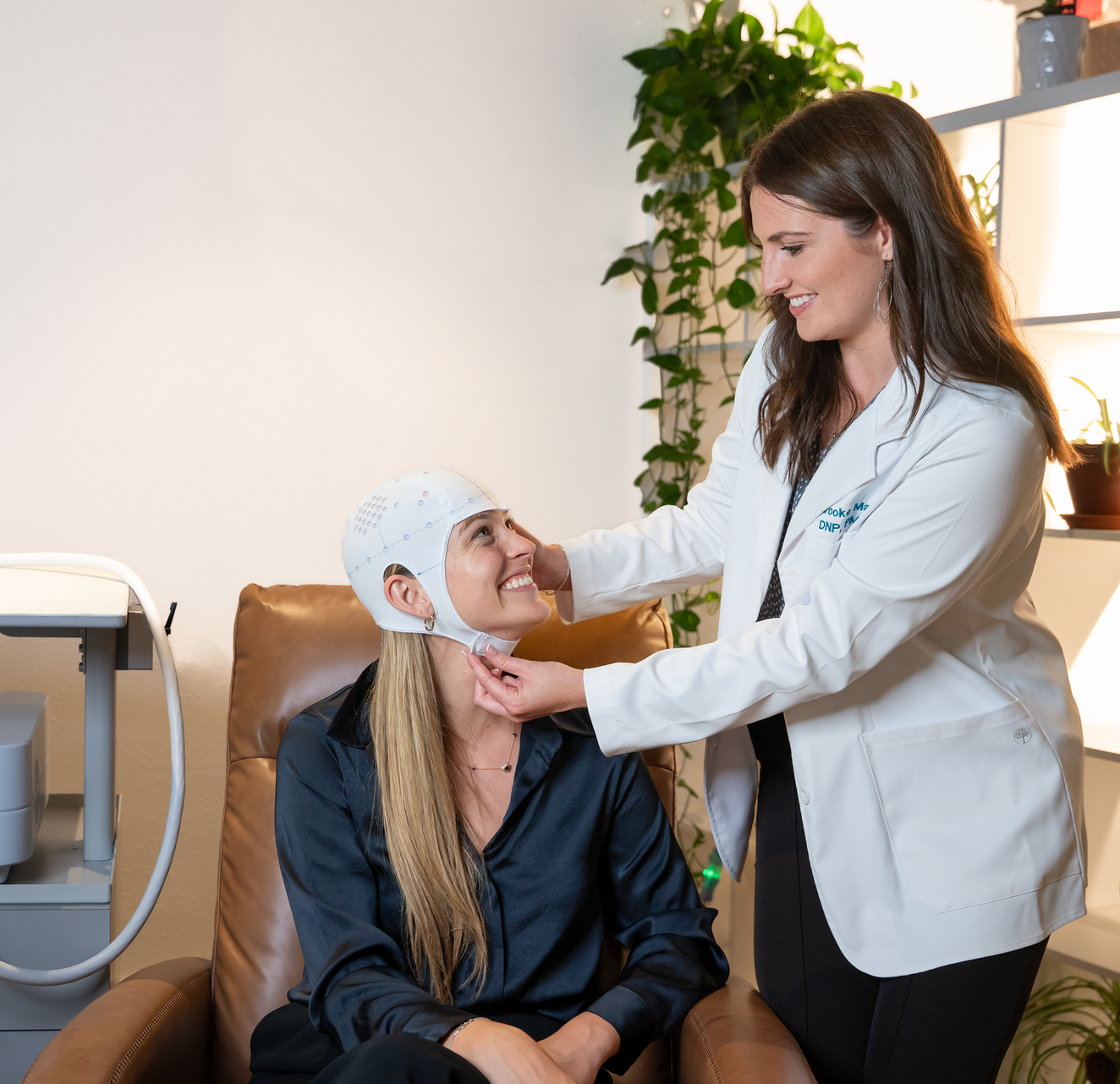
Clinician fitting a protective dental cap on a smiling patient in a modern exam room
By Charles Shuman • September 23, 2026
TMS for depression, explained: no medication, no anesthesia, and you drive yourself home. See who it helps and what it costs in Denver.
Person sitting by a window, holding a mug and looking outside at a mountain view.
By Charles Shuman • September 22, 2026
What ketamine-assisted therapy actually involves at our Denver office, from the first call to after your session, written by board-certified psychiatrists.